Page: [1] [2] [3] [4]  

The Chinese calendar presents an interesting challenge. Although considered a lunar calendar, it has many aspects of a solar calendar. It is as close to a pure astronomical calendar as one can find. Like the Jewish calendar, the Chinese calendar can have 6 different year lengths: 353, 354, 355, 383, 384, 385 days, but the manner in which the year lengths are determined is quite different from the Jewish.

Like the Islamic calendar, the first day of the Chinese month always begins with the New Moon. This would give the Chinese month length either 29 or 30 days in length. (The average synodic month is 29.53059 days.) The Chinese Calendar goes beyond merely computing the moon and noting the position of the next New Moon, because it also considers elements of the solar cycle. A regular year will have 12 months. A leap year will have 13 months. A leap year is determined by other astronomical observations.

Right Ascension, Declination Latitude and Longitude


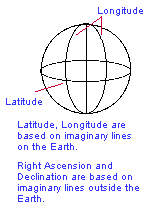
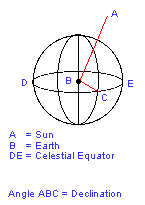
We all are aware of the concept of painting and imaginary grid on the Earth and moving through this grid in terms of North-South/East-West. Those lines form our Latitude/Longitude. That imaginary grid works if you are above the Earth, looking down onto the Earth. Similar to Latitude/Longitude, astronomers paint the heavens with an imaginary grid that helps in determining where an object is in the sky, relative to where the viewer is. Pretend if you were looking out at the night sky, you'd see a grid across the heavens. That grid, requires you to be on the Earth, looking outward. The elements in creating that grid are: Right Ascension and Declination. Think of Right Ascension as the celestial equivalent of longitude; Declination as the equivalent of latitude.

The Chinese Calendar consists of calculating 24 specific points from a known location (120 E) at regular intervals (every 15 degrees). These 24 points are called the Jié Qì The next step is to see where each of the Jié Qì appear in the monthly cycle. (Not to complicate things too much, but the 24 Jié Qì are divided into 2 groups: the Principal Terms and the Sectional Terms.) Each month must have 1 Principal Term. If it is not possible for a month to contain a Principal Term, then a leap month is added.

As a general rule of thumb, the 12 Principal Terms are occur in the following location in the Gregorian calendar:

Term (Approx.) Date
1 Feb. 19
2 Mar. 21 (Spring Equinox) 0°
3 Apr. 20
4 May 21
5 June 22 (Summer Solstice) 90°
6 July 23
7 August 23
8 September 23 (Autumn Equinox)180°
9 October 24
10 November 22
11 December 22 (Winter Solstice)270°
12 January 20

Think of the Chinese calendar as a lunar calendar made to conform to solar rules. Solar observations are overlaid on top of the lunar cycle. It is not possible for each Principle Term to always align themselves neatly inside a lunar month. There will be times when a month does not contain a Principle Term. A leap month needs to be inserted at that point. Unlike other calendars, the Chinese calendar leap month is not inserted at a regular location. The location of the leap month varies from leap year to leap year. It depends upon which month lacks the prerequisite Principal Term. The month that does not have a Principal Term, takes the name of the previous month, with the indicator (Leap) to show that it is a leap month. Thus, the fourth month is: 四月. The leap month is signified by the character: 闰. So, if a Leap month were inserted after the fourth month it would be written: 闰四月.

Modifications over Time Throughout its long life, the Chinese Calendar has undergone some major changes. So substantial were these changes that in reality, they must be considered a separate calendar in its own right. The rules for the early Chinese calendars and the current Chinese calendar cannot co-exist: they are mutually exclusive. Early calendars used approximate numbers for the position of the moon, based on its average position. Other reform attempts imposed a regular repeating pattern of predictable month lengths and year lengths over a given period of time. On any given day, the calendar might not always start at the New Moon, but its over all accuracy was rather high. It was in the year approx. 1645 (Gregorian) that the Chinese calendar became what it is today- a calendar, not based on averages or a regular repeating pattern but on pure astronomical observation. For this reason, our calendar programs, do not regress the current Chinese Calendar to pre 1645 as any calendar displayed in that period would be meaningless. We do not know exactly when all the other reforms took place, but their impact was significant. Associated with the Chinese reforms of 1645 which converted the calendar into a purely astronomical one, the Chinese also kept quite a bit of legacy calendar definitions, mainly their love for cycles. It is this 60 element cycle that defines the name of the day, the month and the year, while astronomical observation determine when the next New Moon (and therefore start of the month) will be.

Page: [1] [2] [3] [4]